Traps as Artworks and Artworks as Traps. Towards a model for life-sustaining art.
Practice based PhD research (2018 – 2025)
equirectangular sketch of Alfred Gell's fictional museum of artworks and traps, pencil and digital collage, 2019
This practice-related PhD asks how anthropology can inform art practice, and vice-versa, explored through an ethnography conducted in parallel with four art commissions. The thesis is shaped by my creative collaboration with Nigel — a professional molecatcher whose interest in art and education led to conversations which catalysed my own comparative toggling between art practice and hunting practice, as well as art and anthropological perspectives. Working with Nigel and other pest control hunters in rural North Yorkshire, I investigate the creative mediums and methods they employ to negotiate boundaries in the land and differences in species perspective. I probe the underground reciprocities that form between the repressed perspectives of ‘pest’ animals, land spirits and working-class hunters, tracking them under hedges and fences as they harness and entrap inalienable value from places where none is conventionally perceived.
In the accompanying practice-portfolio I explore four ways of doing this artistically. Moving between written and practice-based work, I chart the tensions between a silenced “Hunting Attitude” and a dominant “Natural Attitude” in England and explore the ways in which this perspectival discrepancy can itself be worked to the hunter/artist’s advantage. I also call upon Metis (a trickster intelligence and goddess of traps) to articulate “reverse creativity”—the particular kind of practical intelligence that is needed not only to set a good trap, but also to escape one.
A “Hunting Attitude” adopted in art proposes situated practice that yields to the perspectives of nonhuman others, engaging the complexity of death-work and drawing attention to purifying boundary-structures that might themselves be probed, entered and inhabited in a life-sustaining way. This in turn suggests methods for negotiating between art and anthropological perspectives, and ways for undermining and re-rooting extractive and anthropocentric frameworks of thought.
This research is based between the UCL Department of Anthropology and the Slade School of Fine Art, co-supervised by Martin Holbraad and David Burrows.
Link to view /download thesis: https://discovery.ucl.ac.uk/id/eprint/10207642/7/Spriggs_10207642_Thesis.pdf
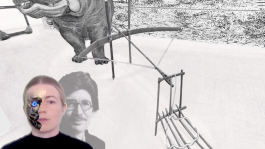
above: still from performance lecture "Traps as Artworks and Artworks as Traps. A tour of Gell's Fictional Museum"
The project takes off from a fictional exhibition described by Alfred Gell in his 1996 essay “Vogel’s Net: Traps as Artworks and Artworks as Traps” and an ethnography of rural pest control as it is practiced in and around the North York Moors. Treating traps as sites in which a range of often contradictory perspectival relations come into focus – hunter and prey, human and non-human, society and nature, economy and environment – this ethnography zooms out to situate the nexus of the trap in a broader mesh of natural, social, economic and political relations, and zooms in to consider the multi-sensory aesthetics of trapping as a form of “art practice” geared towards beyond-human thought and perception.
Above is a virtual rendering of Alfred Gell’s fictional exhibition. At the start of this research I recreated this exhibition, faithfully following Gell’s description, using analogue sketches and collage to build a three-dimensional environment that can be entered and explored. My main objective in manifesting the fictional gallery environment was to test and explore Gell's core argument: That animal traps – a particular genre of artefact – are as technically sophisticated and conceptually enchanting as Western works of contemporary art.
This fictional exhibition is also the setting for a performance lecture. In the lecture different artworks and traps perform as characters or ‘plot holes’ that lead into various approaches and conundrums relating to traps and entrapment.

During the early stages of this research I started spending time with Bob, the guy responsible for pest control at UCL. I witnessed the clandestine operations involved in banishing mice and rats from the UCL kitchens and the Slade School of Fine Art—part of a larger structural project of nature-culture purification taking place within the art school and its exhibition spaces. I also started to think about Bob's traps as artworks in their own right, and his practice of tracking mice and other pests as a kind of art-anthropological research, an "anthropology of other animals" (a lecture-performance drawing from my time spent with Bob can be viewed at the link below). This initial collaboration led to longer-term ethnographic work with rural pest control hunters who also hunt and trap for subsistence around the North York Moors, informing a written thesis and a series of public commissions and material experiments which are archived in the "projects" section of this website.
below: "Traps as Artworks and Artworks as Traps: A view of the Slade School of Art from a Pest Control Perspective". A talk given for the Multimedia Anthropology Lab 2021 conference "Multimedia Encounters"
FIELDWORK IN YORKSHIRE
In November 2020 I moved to my fieldsite, located in Stokesley, a small market town on the northwest side of the North York Moors. My PhD research from this point on is firmly grounded in ethnographic fieldwork with pest control practitioners in rural North Yorkshire. Through a close study of the knowledges, technologies and techniques employed by working-class hunters to track and trap animals, I have been exploring hitherto undocumented forms of human-animal communication, land-based subsistence, and practical ecological knowledge in England. A key objective of this practice-related research is developing ways to conceptualise and instigate new forms of art making that are attuned to local land-based knowledges, along with the intimacies and paradoxes that arise from attempts to control ‘vermin’ species. Material experiments, exchange-based and public comissions arising from this fieldwork are documented in the 'projects' section of this website.